
Civitavecchia's archaeological museum is housed in the 18th-century palace of Clement XIII,
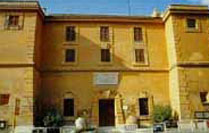
built for the command of the papal garrison. It holds finds from the city of Centumcellae (the ancient name of Civitavecchia) and from the wider territory, as well as from immediately neighbouring areas. The museum occupies three levels; the top floor is used as a restoration workshop.
On the ground floor, among the pieces of particular historical and archaeological interest,
is a Statue of Apollo (1st century AD), found during excavations at the modern Villa Simonetti in Santa Marinella, thought to have been the summer residence of the jurist Ulpian. Recent studies have identified the statue as a reproduction of the so-called Colossus of Rhodes. Equally important is another sculpture from Ulpian's villa: a replica of Phidias's Athena Parthenos, dating to the mid-2nd century AD; the head is now displayed at the Louvre Museum. In the centre of the room are several marble heads, including one of the young Emperor Marcus Aurelius. An adjoining room shows inscriptions from various sources.
A spiral staircase leads to the first floor, with ceramic and bronze materials from Civitavecchia, Tolfa, Allumiere, Luni sul Mignone and Santa Severa. Notable bucchero pieces include an impressed cup (7th century BC), a splendid balsamarium with a kneeling female figure before another, of Egyptian inspiration and origin (6th century BC), and several black-glaze ceramic vases (4th century BC). Among the metalwork are a bronze ring and a finely crafted gold earring.
The second floor displays materials of various origins, including areas beyond Civitavecchia, arranged by class and chronology. The first section holds Villanovan finds; among the grave goods are a biconical urn and a hut-shaped urn, both from the 7th century BC. Among the many bronzes the most important are a series of fibulae, engraved mirrors and a splendid helmet. Ceramic materials from the Cerveteri area (7th century BC) are also on show. Of great interest is the series of black- and red-figure vases of Attic import. The tour ends with a collection of medieval pottery found in the area of the Rocca attributed to Bramante.
National Archaeological Museum of Civitavecchia
Largo Cavour, 1
00053 Civitavecchia (RM)
Tel. 0766/23604
Opening hours: Tuesday to Sunday, 8:30 a.m. to 7:30 p.m.