
Civitavecchia preserves a monumental heritage linked to the port, papal fortifications and the historic urban fabric. Here are the main places to know.
Forte Michelangelo
After the sackings, fires and massacres suffered by the city towards the end of the 1400s,
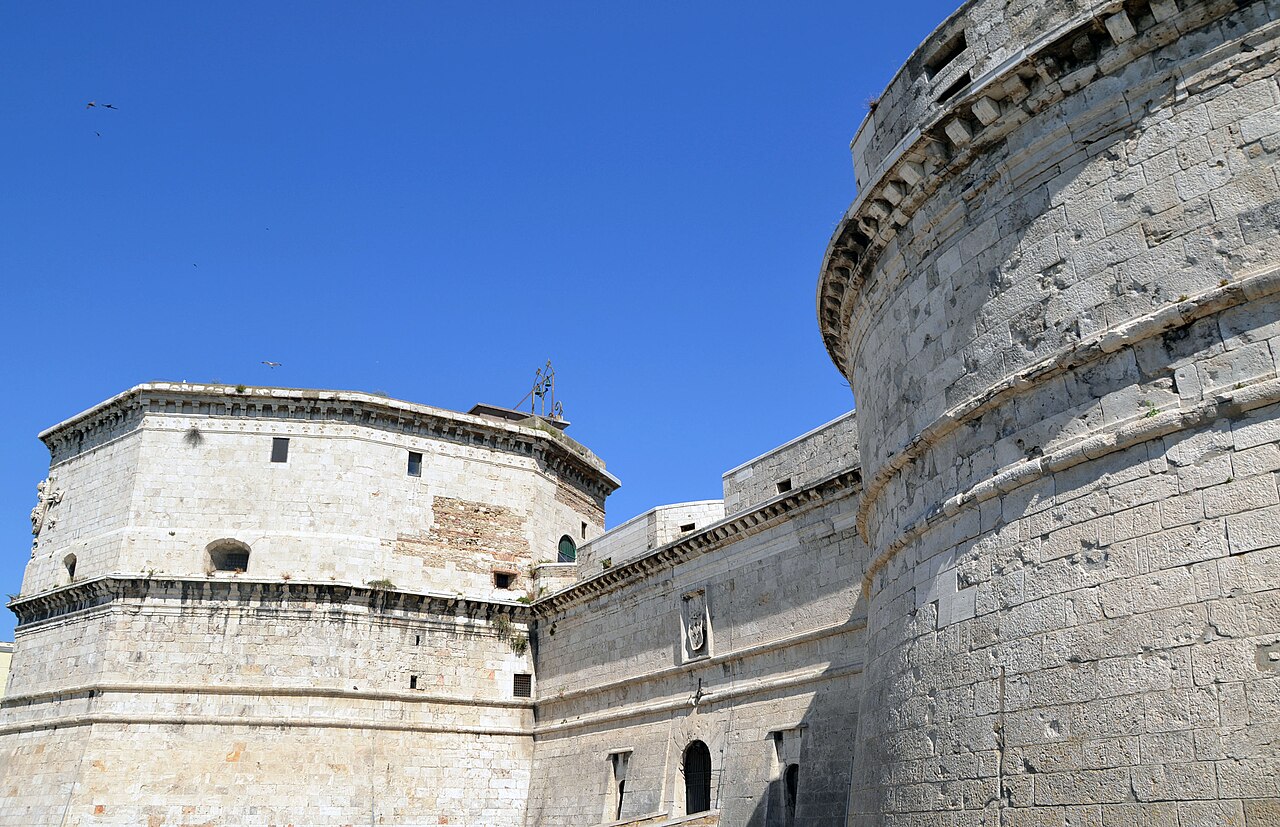
and facing the ongoing pirate threat along the Civitavecchia coast, Julius II della Rovere — elected pope in 1503 — decided to equip Civitavecchia with a fortress. It was to defend the port, the key to communication with Rome, and give security to citizens who had fled to the nearby hills to escape invasions.
Works were directed by Bramante, who died on 11 March 1514 without seeing them finished. They continued under Giuliano Leno and Antonio da Sangallo. The fortress was completed in 1535 under Paul III Farnese. The upper part of the keep (Maschio) remained to be finished: the task was given to Michelangelo.
Forte Michelangelo is among the largest built in that era. It is a quadrilateral with four towers at the corners and an octagonal keep. The walls are faced with travertine; a moat once ran around it — now gone — and its infill hides the base under the scarp. Higher up the wall returns to vertical, with a cornice on classical-style brackets. Parapets have openings of varying width for arquebuses or cannon. The fort could be isolated from the rest of the fortress for a last stand.
The old entrance opened between the keep and the western tower: the bronze pulley of the drawbridge is still visible; on the jambs is carved the order «LASCIATE L'ARME» (Leave your arms). The four bastions are named San Colombano, Santa Ferma, San Sebastiano and San Giovanni. In the San Sebastiano tower there is an underground corridor, a secret landward exit thought to have emerged inside the city walls. In the Santa Ferma tower, once in contact with the sea, a small chapel to the city's patron saint has stood from the beginning.
The fortress stands on a vast Roman imperial building, perhaps a barracks for the fleet and Trajan's harbour. Exploration revealed a room with an almost intact geometric mosaic floor.
Vanvitelli Fountain
In 1630, when the port's free-trade status was restored, it became necessary to separate it
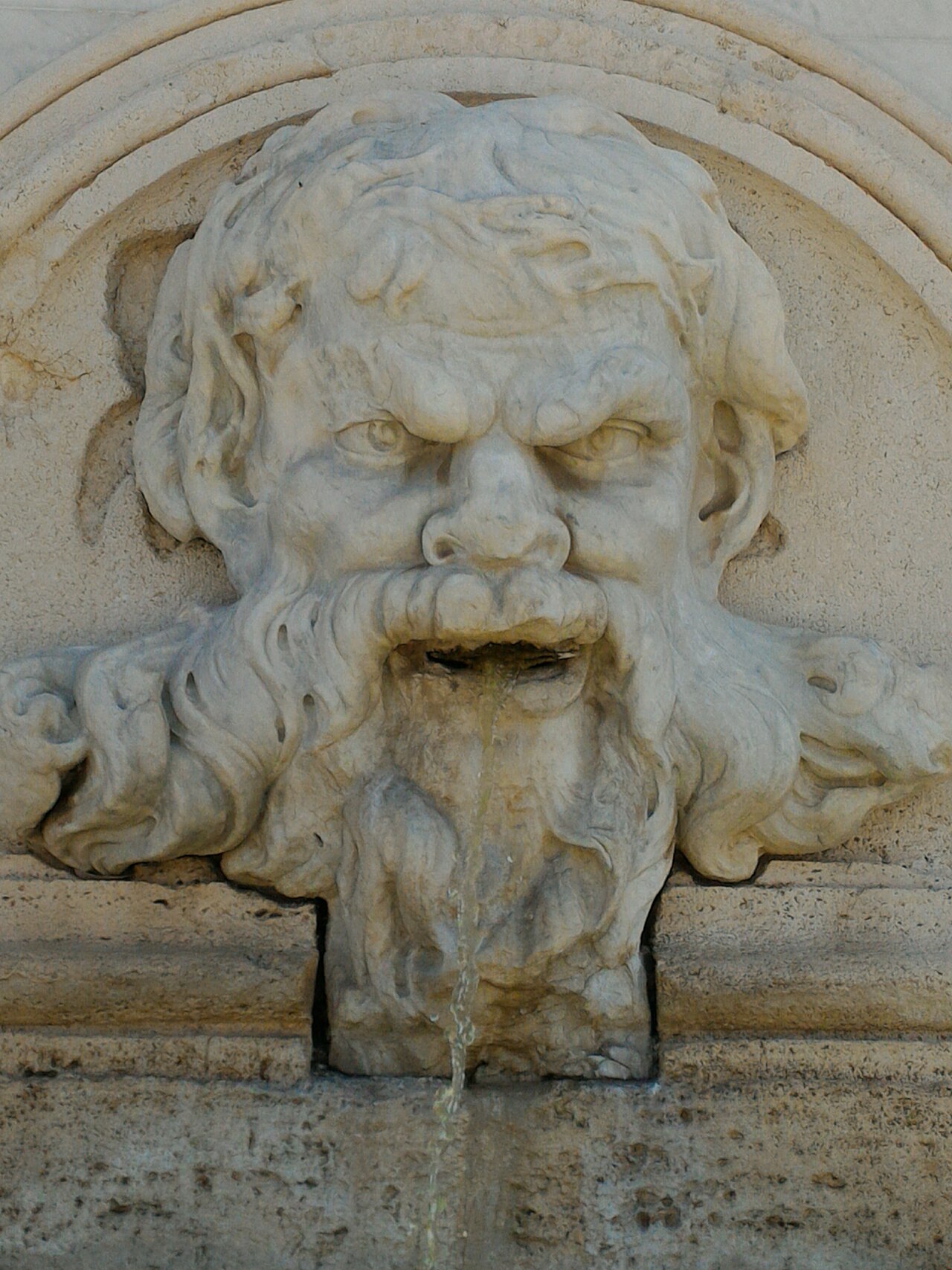
from the city. Urban VIII had the still-standing seawall built, also completing defence towards the sea. Paul V had already faced the risk of sudden landings too far from the fortress. Even after the wall, barriers of nets, beams and chains anchored to the mole forts were planned at the harbour mouths. The wall covered remains of buildings around Trajan's harbour; at its base, in spaces now used as a fish market, original opus reticulatum masonry remains.
In 1740, under Benedict XIV and to a design by Luigi Vanvitelli, the wall was adorned at the centre with the travertine fountain. A harmonious curved staircase ran down to the water; today it is trapped in the «Principe Tommaso» quay and the area has lost the gathering character that for centuries made the port a hub of city life.
The Ancient Port
Until a few decades ago the port could be considered an architectural jewel:
the fundamental structure of the Roman work was unaltered. The popes had only replaced temples and porticoes destroyed by time and people. Designers called by the popes included Bramante, Michelangelo, Antonio da Sangallo and Bernini. Modern works have partly changed the harbour lines but left the artworks intact, or nearly so.
To the east, the keep of Forte Michelangelo is reflected in the water; nearby the arches of the Bernini Arsenal recall ancient Rome. Towards the city the port is closed by Urban VIII's brick seawall, broken at the centre by the Vanvitelli Fountain. To the west, after Porta Livorno, rise the walls of the old Rocca with its square tower, said to date from the time of Callistus III.
Beyond the mouth of the old Roman Darsena — in whose depths the colossal bronze statue of Neptune may still lie, of which an arm came to light in the last century — stand Antonio da Sangallo's bastions (first half of the 16th century). Of the original enceinte only the part around the old dock remains. From Roman times one of four towers survives, called «il Bicchiere», at the end of the mole of the same name. On the opposite Lazzaretto mole there is a similar tower, not the ancient one but on the same site. In place of the other two Roman towers on the breakwater stand the Gregorian Fort (Gregory XVI, first half of the 19th century) and the Lighthouse (1616, Paul V), still in service after more than three centuries.
Through the small porch along a side of the Rocca, in large travertine blocks, one reaches the old dock. In the little square stands Porta Marina, with flat travertine pilasters, Ionic capitals and two granite columns. The water basin already existed in Roman times, as finds of ancient objects attest; recently fragments of Doric travertine columns and capitals from the quay portico have emerged. Part of the stone-block wall dates to the imperial age; 16th-century popes restored it, adding classical-style bronze lion heads with mooring rings in their jaws.
La Rocca
From Porta Marina one enters Piazza Calamatta, faced by the 16th-century palace built largely
under Pius IV on the walls of the ancient Rocca. The building shows various periods, especially on the harbour side. Despite changes after 1500, the enclosure is still recognisable: its origin is ancient and attributed to the feudal lords who held Civitavecchia, founding it on the ruins of the Roman port.
The Rocca was quadrilateral and rose sheer above the dock mouth. Around the mid-1400s it was altered and enlarged with two towers, one towards Porta Marina and the other, now hidden by later buildings, near Porta Livorno. Holding the fortress meant holding the port, the key to Rome: hence bitter struggles. It holds the memory of the city's major historical cycles, from maritime greatness to defence against invasions.
Il Pirgo
The name Pirgo comes from the people of Pyrgi, who lived on the Latium coast before Rome.
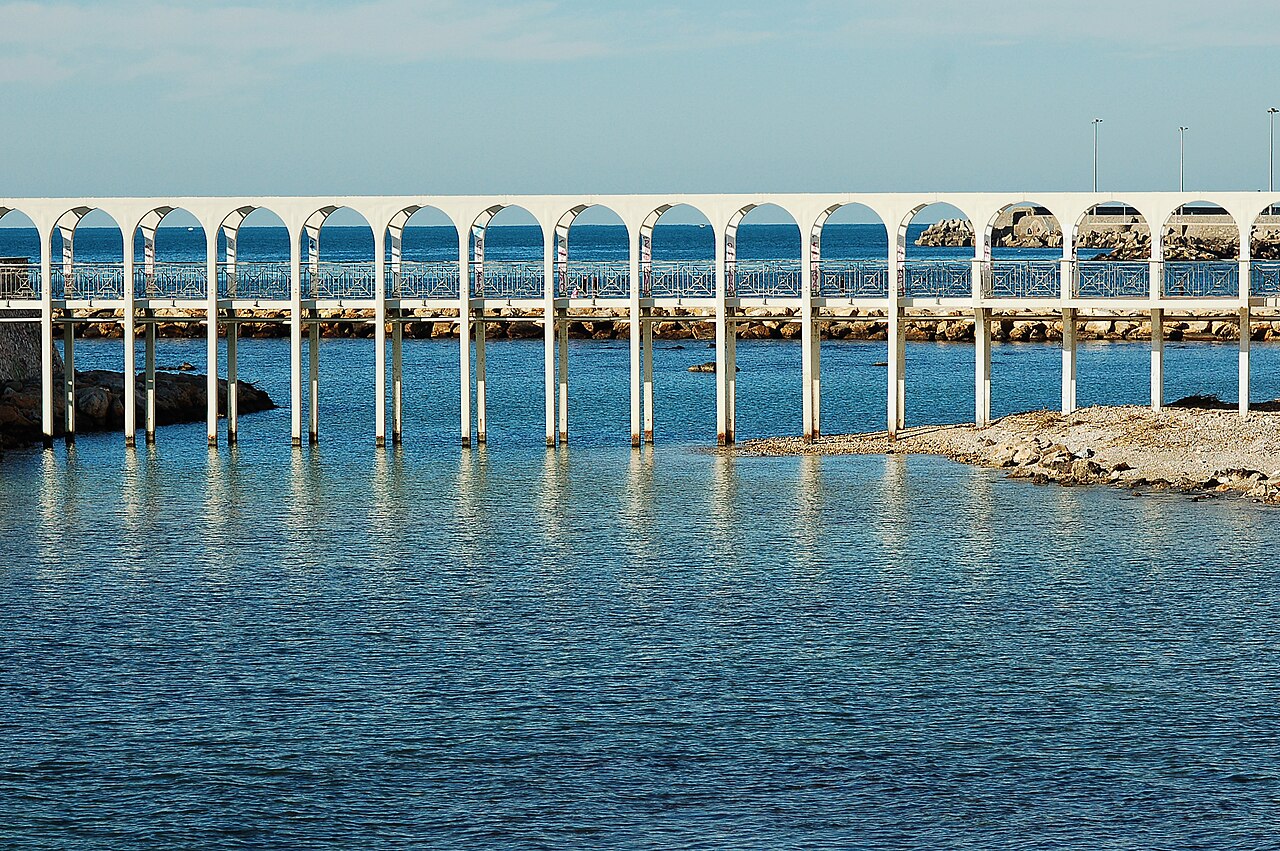
It was given to one of the first two bathing establishments built on Civitavecchia's seafront in the second half of the 19th century. The complex, on an islet, had a platform, jetties, rotundas and Swiss-chalet-style buildings and soon became one of Italy's finest. Destroyed a couple of times by storms in 1897–1898, it has been rebuilt with an ambitious project that also involves the facing promenade, returning the establishment in modern form to residents and visitors.
Piazza Leandra
In the heart of the medieval quarter, Piazza Leandra is the city's oldest square.
At its centre is a historic fountain named after the legendary Leandro, an old seafarer said to have promoted the people's return to the old city (hence «Civitavecchia»), abandoned because of Saracen raids. Citizens had fled inland and founded Leopoli.
Set between two period palaces is the Church of the Stella, one of the oldest. It houses the image of Our Lady of Grace and has been, since 1688, seat of the Gonfalone Archconfraternity founded by St Bonaventure. From here every year on Good Friday evening the procession of the Dead Christ sets out, with hundreds of hooded barefoot penitents dragging ankle chains and wooden crosses. In adjoining rooms underground wall remains are visible, found during sacristy works.
From the square one passes the medieval walls through the «Dell'Archetto» passage, the uphill gate of the 9th-century enceinte, towards Piazza Aurelio Saffi (also called San Giovanni), from which one reaches the Church of Death (of Prayer and Death), the city's oldest. On the gate turret a plaque recalls the return of refugees after the Saracen raids.
La Marina
This is the city's window on the sea. To the north it is bounded by Forte Michelangelo,
commissioned by Julius II in 1508, designed by Bramante, continued by Antonio da Sangallo and finished by Michelangelo Buonarroti, who handed it over in 1535 to Paul III. It was recently redeveloped after removal of the railway easement that took trains from the station into the port. It is now a venue for cultural and social events, including of national importance.
South of the fortress, in Largo Marco Galli (formerly Largo Caprera), dedicated to the local world water-polo champion, is the Municipal Pool, home of the local team. Further south on Lungomare Thaon de Revel are the Pirgo bathing establishment and the Lega Navale harbour, a traditional club of the local sailing community. On 15 August, after restoration, the Pirgo frames the historical re-enactment of the Saracen Assault on the city.
Viale Garibaldi
It crosses the southern part of the city, runs along the seafront behind the Marina and links
the station to the port. It takes its name from the life-size statue inland at the centre of the avenue, in memory of Garibaldi and his stay in the city. Suffering from arthritis, the General regained fitness after a stay in August 1875, bathing at Trajan's Baths, known since antiquity.
Nearer the port entrance stands the war memorial, a bronze group by the Turin sculptor Riva. Further south, on the seaward side, a bronze bust by Civitavecchia sculptor Vignanelli commemorates Father Alberto Guglielmotti (born in Civitavecchia on 3 February 1812, died in Rome on 31 October 1893), scholar and writer, author among other works of the Vocabolario marino e militare. Together with the Marina redevelopment, the avenue has been restyled and planted; it is one of the busiest meeting places and often a Giro d'Italia stage start or finish, thanks to the long straight suited to sprints.
Porta Livorno
To ease access to the port from the north, Clement XIII had a gate opened in the enclosing wall,
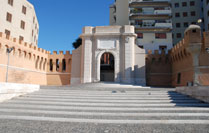
called Porta Livorno because it faced that direction. It shows the popes' interest in developing and fortifying the harbour, among the Tirreno's busiest. The defence walls stood until the last world war, when port and city were almost destroyed by bombing; Porta Livorno shared that fate. Recently, with the City Council and Port Authority, it has been restored to its former splendour, a symbol of a commercial and tourist port open to new Mediterranean horizons and beyond.
Town Hall (Palazzo Comunale)
Seat of the mayor's offices, municipal offices and the city council, it occupies a period
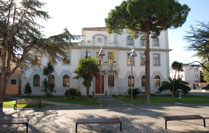
building once the Casa del Balilla. It is also called Palazzo del Pincio, because it stands where before the war there was Piazza del Pincio — named after the Roman garden by Villa Borghese — which, with Piazza Casamatta, were then Civitavecchia's only public landscaped areas. The whole square has recently been restyled in furnishings and planting, with a more functional, modern look.
The Market
Rectangular in plan, it lies in the historic centre on Piazza Regina Margherita,
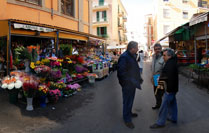
an urban area formed after 1884 when the city walls marking the boundary between town and countryside were demolished. Here the traditional market is held, fixed and itinerant, with a thriving fish market in a masonry structure of 1904. The square is surrounded by buildings and oak trees, with a large palm at the centre. On the short north side is the Compagnia Portuale Roma headquarters: the original building dated from 1911 and has been renovated and modernised in recent years.