
Cathedral
On the main square of Civitavecchia, just before Corso Marconi towards Tarquinia,
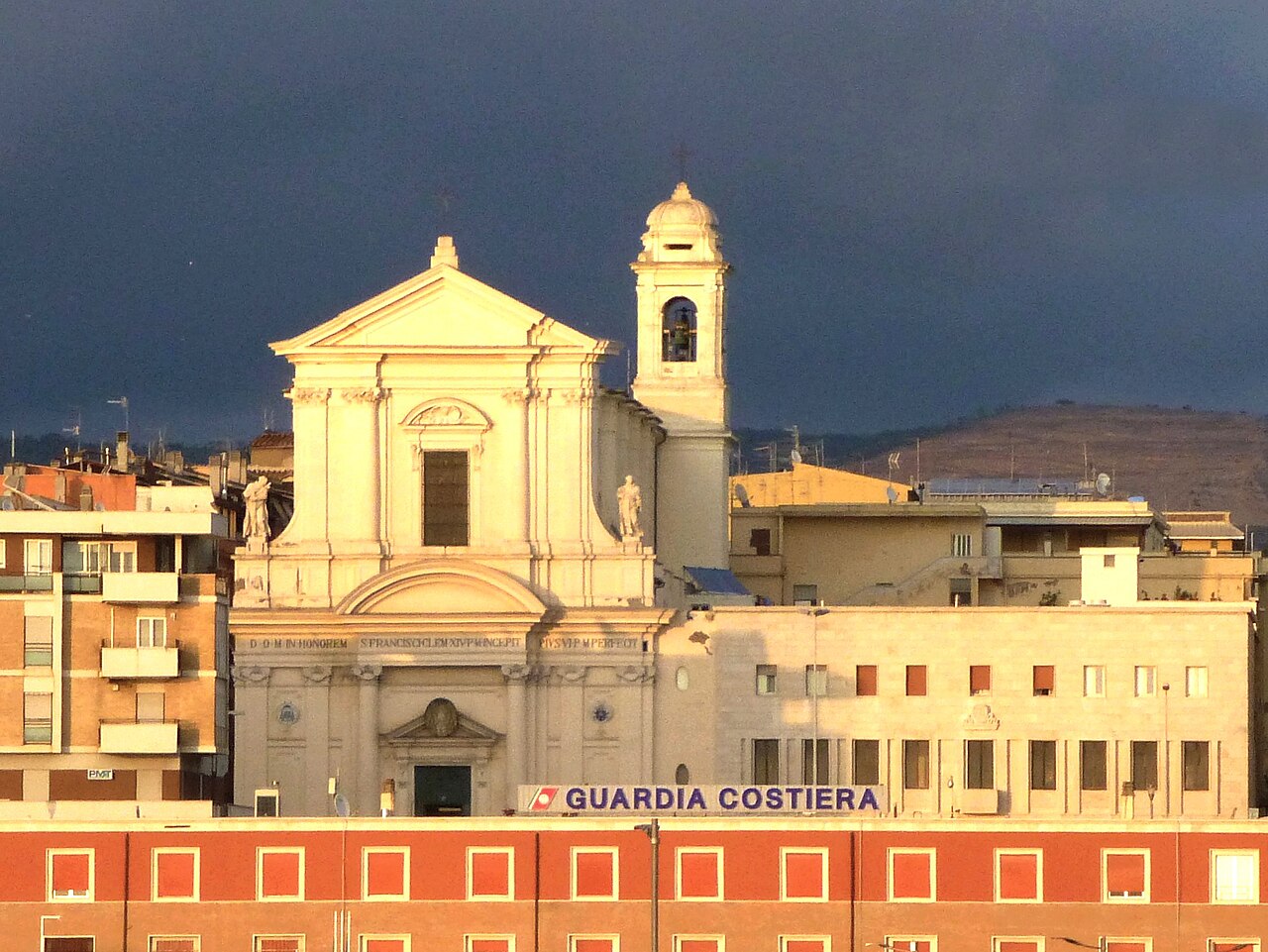
stands the Cathedral dedicated to Saint Francis of Assisi, built on the site of a small church that the Conventual Franciscan friars had been allowed to erect by concession of Pope Paul V in 1610.
More than a century later, as the city grew and the population increased, that church became too small. In 1769 Cardinal Lorenzo Ganganelli ascended the papal throne as Clement XIV; he came from the same religious family as the Conventual Franciscans. The friars asked the Pope to meet the need for a larger place of worship. The Pope granted subsidies and sent the architect Francesco Navona to direct the works. Thus rose the new church destined to become the cathedral of the episcopal see.
The Cathedral has elegant, solid structures that show unusual technical skill. From the main door a comfortable fan-shaped staircase spreads across the façade. On the upper level, supporting the pediment, stand two large statues of Saint Francis of Assisi and Saint Anthony of Padua. Inside, the church has a single nave, tall and long, with symmetrical side chapels between pillars with bases and rich capitals that seem to support the majestic vault. A triumphal arch divides the wide sanctuary, where the great altar of fine marbles stands. Two large columns, detached from the apse wall, support the pediment bearing the statues of Justice and Hope; beneath it, in a rich gilt stucco frame, is Antonio Nessi’s fresco of Saint Francis receiving the sacred Stigmata at La Verna. The chapel paintings are of little note except that in the middle chapel on the right as one enters, of great value: it shows the Nativity of Our Lord and is attributed to the school of Domenico Zampieri, known as Domenichino. The tower bells are of historical interest because they were cast from the metal of two cannons given by the Pope.
When an episcopal see and therefore a cathedral church were needed, Saint Francis’s was the largest and most suitable church in the city. By agreement between the Municipality and the Franciscan friars, the latter kept the church and convent they still hold in Piazza degli Eroi, ceding to the Municipality — which reserved the jus patronatus — the new church with its adjoining convent, partly for the bishop’s residence and partly for the seminary. Thus in 1805 the church of Saint Francis became the Cathedral of the Diocese of Civitavecchia.
Church of the Orazione e Morte
This small church, notable for its Greek-cross plan and simple, elegant lines,
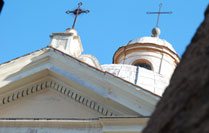
was built in 1685. It became the seat of the ancient venerable Confraternity of Death, an institution existing since the second half of the 16th century and still its owner; it was almost completely restored in 1702.
It is round in form and crowned by an elliptical dome; it has three altars: the high altar opposite the entrance and the other two in ornate chapels facing each other. Four symmetrical doors lead respectively to the Blessed Sacrament chapel, the Oratory, the sacristy and the wardrobe. Worth admiring are the fine frescoes by Cavaliere Giuseppe Errante of Trapani decorating the interior of the dome, and two wooden statues of Christ Crucified and Christ Risen.
Church of Our Lady of Grace (or della Stella)
It stands in Piazza Leandra and is perhaps one of the oldest churches in Civitavecchia.
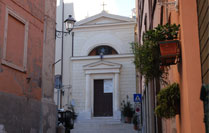
It is the seat of the Archconfraternity of the Gonfalone. The Company of the Gonfalone began in Civitavecchia in 1274: according to a constant tradition, Saint Bonaventure, on his way to the General Council of Lyon in 1274 on the Pope’s behalf, passed through the city and was earnestly asked by many devotees to enrol them in the pious Union of Those Recommended to the Most Holy Virgin, which he had founded in Rome in 1263. The institution later took the name Company of the Gonfalone because, during the strife and turmoil in Rome in 1354, the Recommended confrères managed to stop the slaughter and restore calm by invoking the Virgin Mary and showing that the Holy Cross should be the emblem, banner and gonfalon of peace and justice.
Wishing for their own church and oratory, the confrères obtained in 1688 from Brancacci, Ordinary of Civitavecchia, the church of the Stella, which they enlarged, embellished and furnished with rich sacred fittings at their own expense. Inside, besides the fittings, a wooden statue of the Virgin is notable.
Church of the Holy Japanese Martyrs
It stands at the end of Viale della Vittoria.
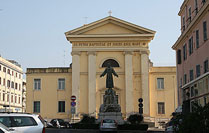
Built in 1864 on Largo San Francesco d’Assisi, it is dedicated to Saint Peter Baptist and his twenty-five companions martyred in Nagasaki on 5 February 1597. Completely rebuilt after the war, it was greatly embellished by frescoes of the Japanese painter Lucas Hasegawa.
Other churches
In the territory there were various churches and hermitages, now abandoned and largely destroyed. Worth mentioning are:
The church of San Giovanni: it stood near Trajan’s Baths and already existed in the time of Saint Gregory the Great (AD 600), as attested by a writing of the Saint stating that in his day the Baths were inhabited, there was a church dedicated to Saint John, and the territory belonged to Centocelle. Of the church, about 23 metres long and 20 wide, only a few stretches of the perimeter walls remain; the small Romanesque bell tower survives.
The Hermitage of the Trinity: it stands in a picturesque spot by the sea, near Torre di Bertoldo (also called Sant’Agostino); it was founded by the Augustinians. Today it is completely destroyed, but it still existed in the 15th century. According to tradition, Saint Augustine stayed there for a time and there received the miraculous answer concerning the mystery of the Most Holy Trinity.